


Looking for something specific? Enter keywords to discover content, stories and experiences.
Close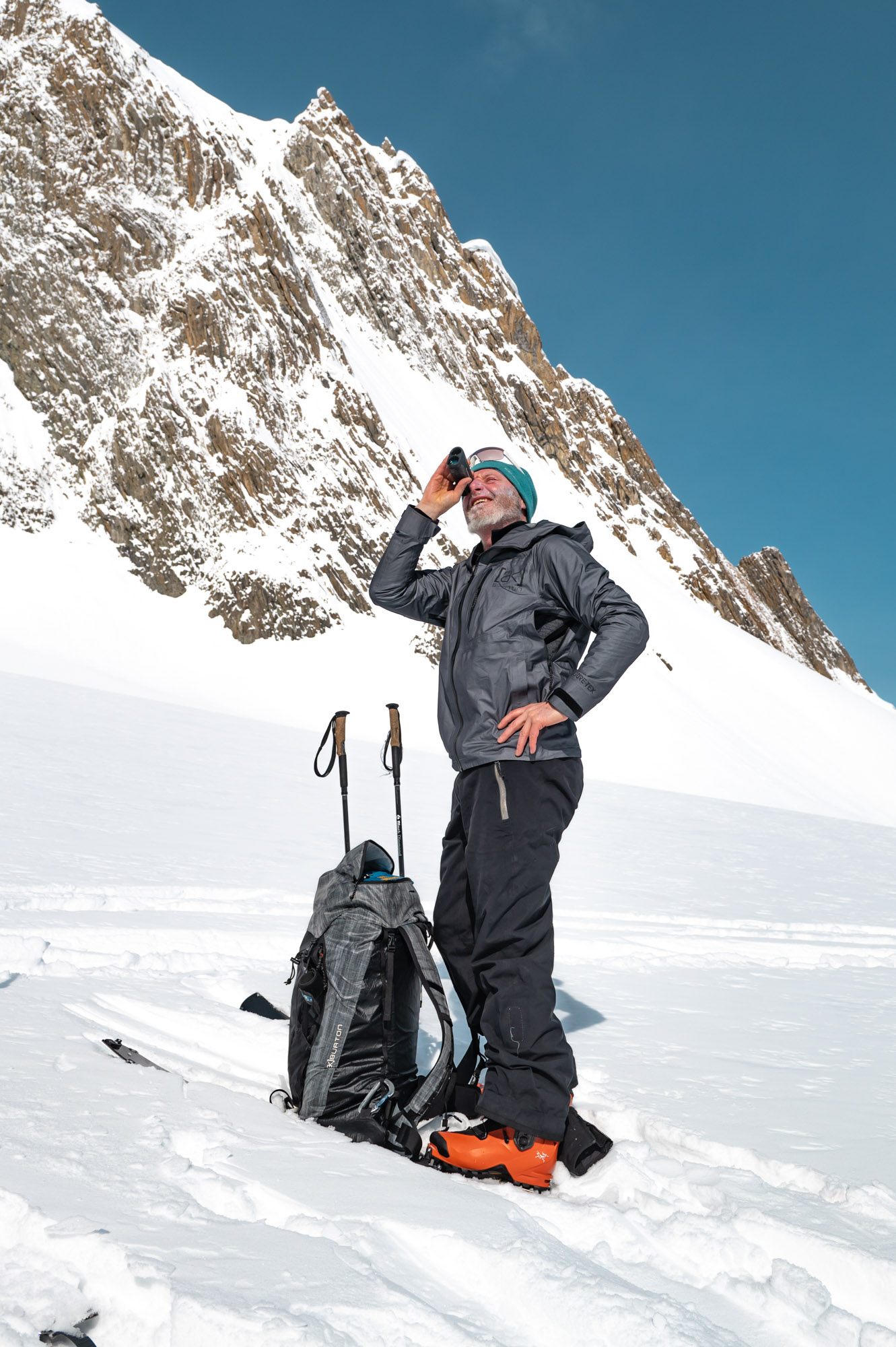
April 7, 2026
Photo
Dustin Lalik
April 7, 2026
Photo
Dustin Lalik
Mountains can move in seconds. John Buffery recalls a midwinter day in 2018 when they did. A backcountry guide, he was leading a team of professional skiers and snowboarders on a mountain near Kaslo, British Columbia. The helicopter had dropped them on the summit to film the first run of the day, bathed in the soft light of the early morning. The peaks around them rose like white sentinels in the stillness of the high alpine, each one holding the story of that winter written in layers beneath their frozen surface. As the film crew readied their gear, Buffery snowboarded down the ridge a few metres to investigate the snowpack. Moving deliberately, he scanned the landscape for signs of instability—scouring for cracks, listening for the sound of snow settling, feeling for weaknesses beneath his boots. Using his probe, he detected a thin crust about 30 centimetres down. But as he moved farther into the bowl, he felt it again. This was unexpected on an east-facing slope given the cold weather. Crusts appear when snow warms slightly before freezing again.
Back at the summit, the crew was ready to shoot: cameras out, boots in bindings, waiting for his signal to drop in. The avalanche risk had been assessed as low that day, and the reports had made no mention of a crust. Yet there it was, with a significant amount of snow resting on top. Based on those quantifiable inputs and an uneasy hunch, Buffery made a tough call: no one would be descending from the summit. They would work their way down the ridge and reassess lower down. He radioed one of the riders to come meet him. As he edged his way down, the snow on the east ridge settled, collapsing the weak layer beneath it and triggering a size 3 avalanche that hurtled over the team’s intended line of descent. The roar of snow tearing downhill echoed through the valley, the rushing white cascade snapping trees like matchsticks. Had they gone ahead, the outcome would have been catastrophic.
John “Buff” Buffery is, among other things, a certified backcountry guide, a Senior Avalanche Officer for the BC Ministry of Transportation, a consultant on major feature films, and a risk management educator. He has spent more than four decades reading mountains, interpreting the subtle language of snow. “The fact that it can shift keeps you hooked,” he says. “Even with all the data, it might still surprise you. You will never know everything.” And it is precisely this uncertainty that fuels his curiosity.
He admits that making these kinds of calls is one of the hardest parts of his job. “I just stick to my task: keeping everyone safe,” he explains. “Over time, I came to understand that my role is pretty clear, and I communicate any concerns I have the best I can.”
Buffery’s nine-to-five job involves such decision-making on a larger scale. He supports eight avalanche teams throughout the province, overseeing controlled releases, road closures, and hazard assessments for the highways through mountainous terrain. “It’s a fascinating job,” he adds. “I carry a mental map of the snowpack across BC and Alberta, updated daily with forecasts, weather data, and reports from other operators.”
“To understand snow, you must see the mountain as a living archive,” he explains. Snowpacks are not static; they carry the memory of every storm, sunny spell, and cold snap. Monitoring them requires both a macro and a micro perspective, tracking every subtle shift and major change in the snow throughout the season.
.jpg)
%20(1).jpg)
Buffery grew up in Toronto in a family of nine. From an early age, he felt drawn to the outdoors, finding refuge in the Boy Scouts and canoeing. One day, after reading a book about the Arctic, he carved a few paddles, hopped on a freight train to Yellowknife, and paddled north to the Arctic Ocean (as one does). Months later he found himself back in civilization, dining at the rotating restaurant atop the Calgary Tower. “As the restaurant turned, I looked east and saw only fields and flatland. By the time I finished my meal, I was facing west—toward the front ranges of the Rockies. I walked out and headed west.”
He eventually began working as a ski patroller at Panorama Mountain Resort, and the more time he spent in the backcountry, the more the snow fascinated him. “I started noticing these crystals on the surface. I had no idea what they were until I learned it was surface hoar. I was so intrigued by the beauty, the sound, the feel of it, that I wanted to learn more.”
Curiosity led Buffery deeper into the science of snow. In the early 1980s, he took a seven-day avalanche course with National Research Council Canada. He went on to study with pioneer Peter Schaerer, who had begun recording snow behaviour in Rogers Pass. “He played a pivotal role in formalizing avalanche safety research and training in Canada,” Buffery says, reflecting on Schaerer’s influence. As soon as new courses became available, he took them. “I just wanted to understand what I didn’t know,” he explains. “I felt connected, as if I was evolving with this fairly new science.”
Generally, when people look at snow, they see only the surface. “It’s really hard to extrapolate what has happened in the past to what is buried in the snowpack,” Buffery admits. “It’s a history lesson.”
When you dig a snow profile, the goal is to create a very clean cut so that the delineations between storms are obvious, even from afar. “Just having that tangible view impacts your brain and decision-making,” he explains. The focus is on the relationship between layers: Is the snowpack unifying into a stable structure, or fragmenting under subtle movements of water vapour and temperature gradients, creating instability?
There are so many variations that any single observation is only part of the larger calculation. Multiple pits, combined with reports from other operators, help form a clearer picture. And yet, even with all this data, forecasting is never absolute. “It’s a best guess of extrapolated information that you apply to the piece of terrain you’re on,” Buffery admits.
As a technician, Buffery is constantly attentive to shifts in the winds, pressure systems, temperature, and humidity. He takes careful measurements and probes the snow, confirming—or questioning—his observations.
Forecasting always involves two kinds of uncertainty: epistemic, or the degree to which our knowledge has been validated; and aleatory, or the inherent unpredictability of random events. Earthquakes, sudden wind shifts, or a skier’s weight can trigger avalanches in ways no model can fully predict. “Most of the weight in decision-making rests on uncertainty,” Buffery explains. “Your knowledge base is what you can measure. The rest is just rolling the dice—that’s why we call it risk assessment.”
“There’s as much science as we can know,” he continues, “but a fraction remains a phenomenon. We think we understand, but so much shows itself unexpectedly.” Yet if every decision starts with observation and every action is rooted in quantifiable evidence, experience also comes into play.
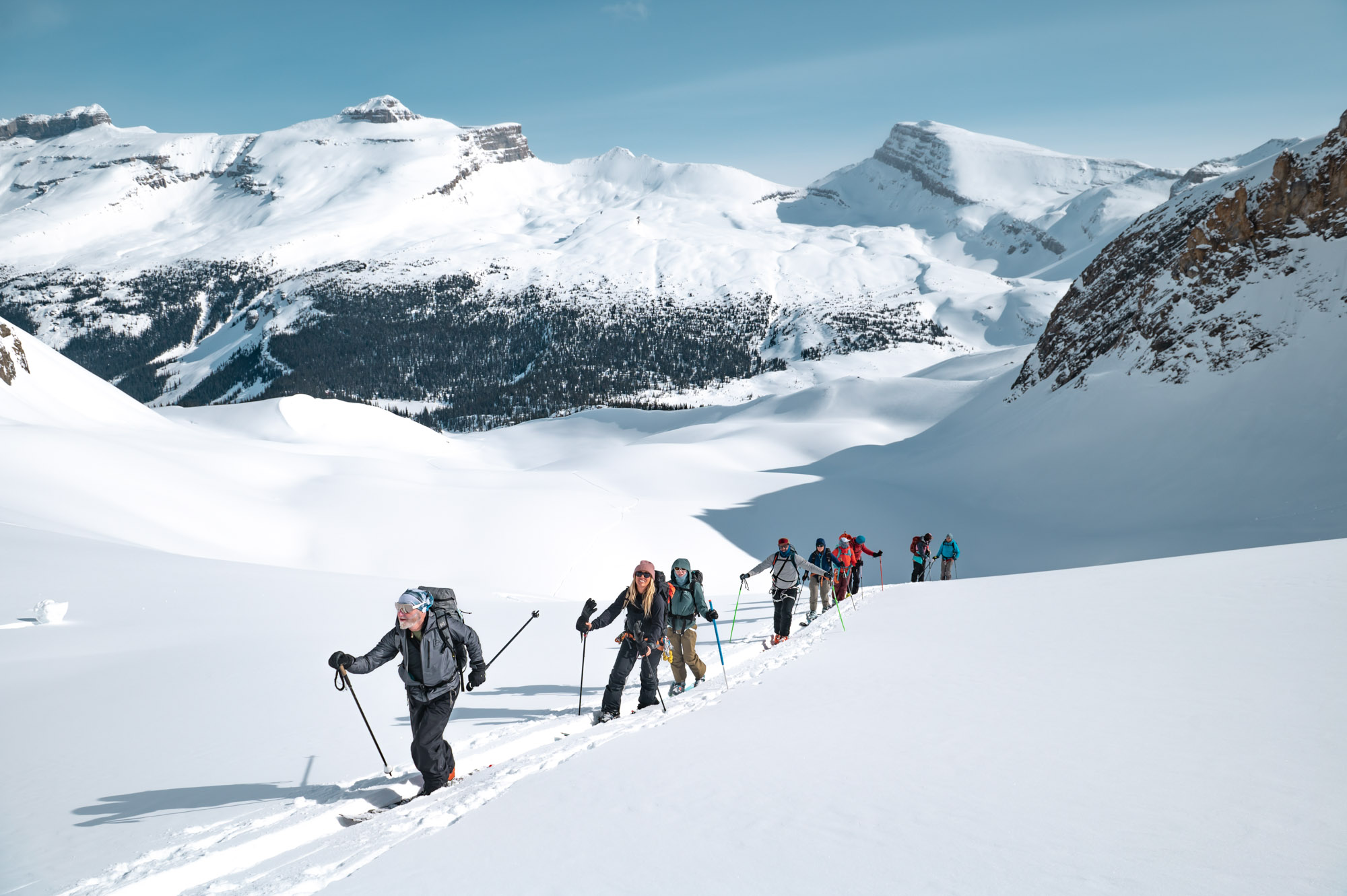
Over decades, a forecaster develops heuristics: a subconscious accumulation of past anomalies shaping their current awareness. You sense that something is off, though you can’t put your finger on just what, and you’re suddenly alert to every tiny detail—the faintest shift in the otherwise uniform snow, the softest sound as it settles. Buffery likens this to the Japanese Buddhist concept of satori—a moment where time stops and you’re very present.
Beyond this experience of awakening or enlightenment, in Japanese mythology, satori can refer to a mischievous mountain yōkai who whispers travellers’ thoughts—a reminder that awareness in the mountains is never just intellectual, but also lived.
Although every decision is grounded in data, there is always a human element. Being fully aware of your surroundings and communicating clearly with the people around you can make the difference at the end of the day. “It’s not obtrusive, it’s not combative, it’s a discussion.”
.jpg)
As a forecaster, Buffery tries to make the world quantifiable, but after more than four decades in the mountains, some of the changes he’s observed can only be described qualitatively. “I can readily see the glaciers receding in my lifetime, and the snowstorms seem to be more intense when they come,” he says. In Nelson, BC, where he’s based, a winter season that once laid down a continuous, stable snowpack now leaves a patchwork of hard and soft layers, brought on by alternating cold snaps and thaws. This inconsistency breeds instability—shear planes and layers prone to collapse—reminding us that the mountains are always shifting, and bear witness to a world in flux. They also teach us to pause, truly observe our surroundings, gain a deeper understanding, and show greater respect. Buffery sums it up nicely: “The key to success in my journey, and in all aspects of my work, has been to stay curious—about everything—and to continue learning.”
For those willing to read the language of snow, each winter offers lessons—in patterns, patience, and the subtle art of paying attention.






NEW ISSUE nº17






.jpg)
.png)
