


Looking for something specific? Enter keywords to discover content, stories and experiences.
Close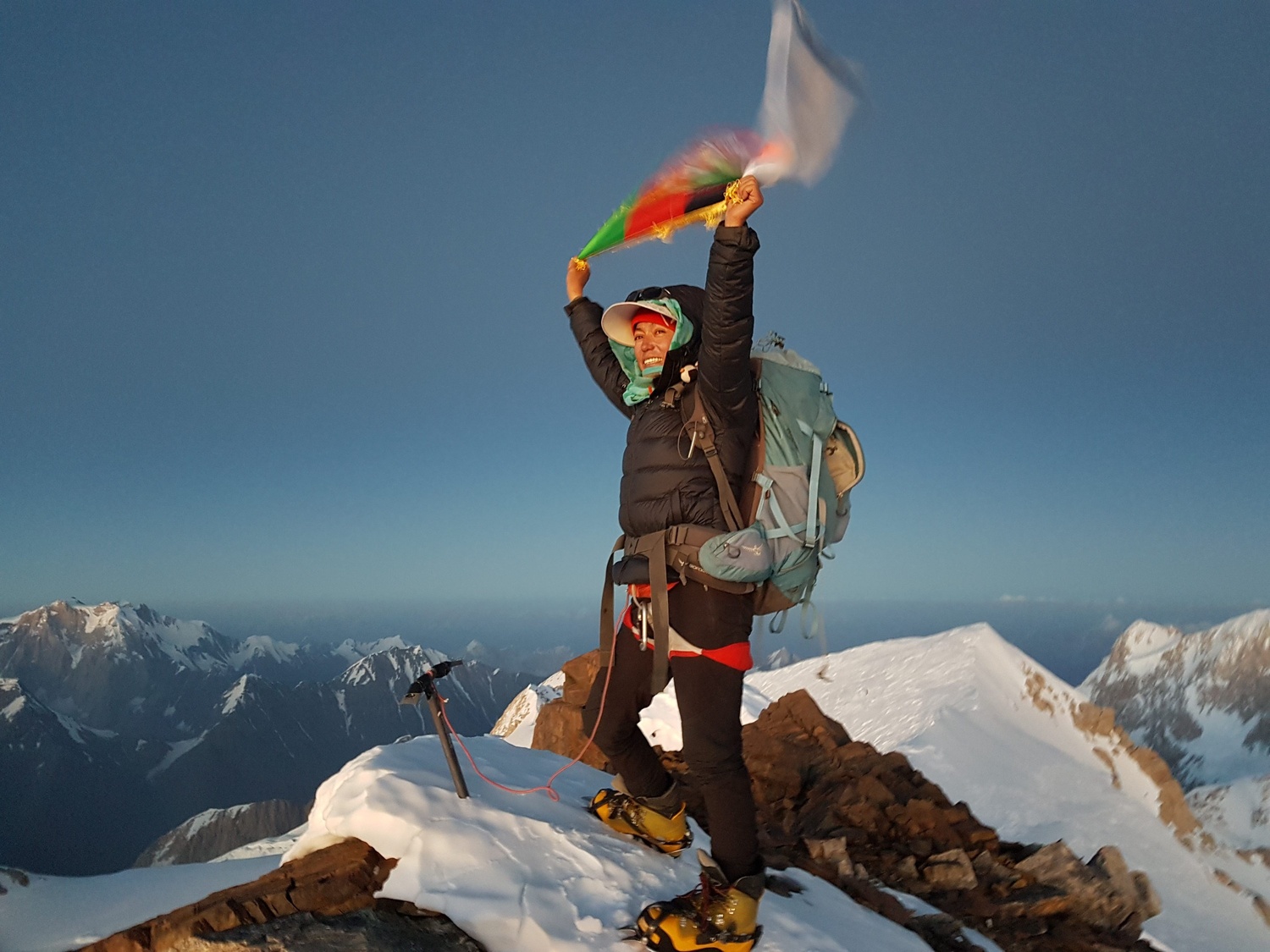
February 5, 2024
Photo
February 5, 2024
Photo
Even so, this remote precipice at about 22,000 feet felt safer to Hanifa than most places in Afghanistan. Not only because of her American expedition leader Emilie Drinkwater’s penchant for caution, but because of what life is like for Hanifa and other Afghan women below.
Up high there is no terrorism, no misogyny, no poverty. Hanifa, who cannot read or write, describes it eloquently: “I feel free when I’m on the mountain, like a nightingale let out of its cage.”
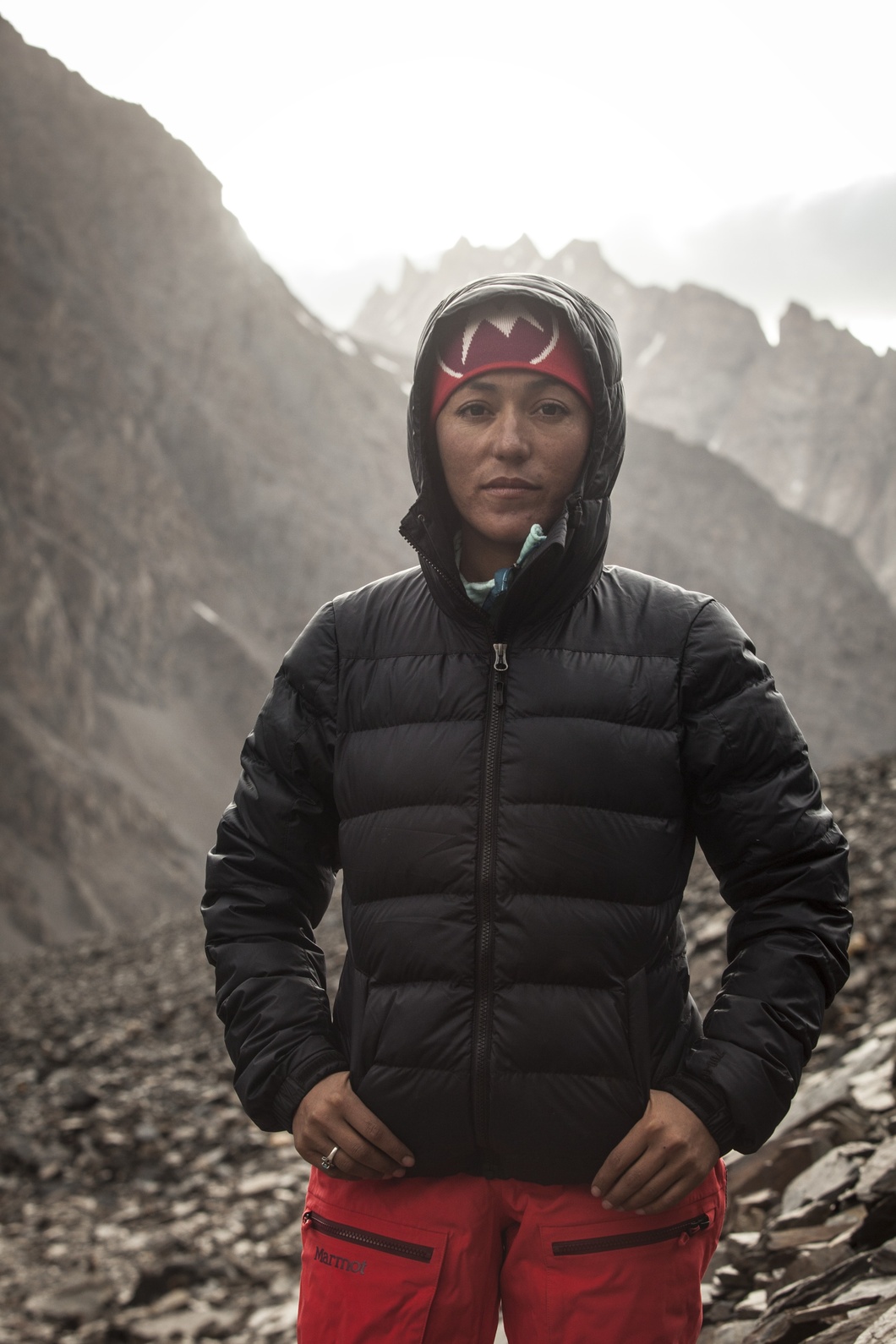
The 26-year-old from Kabul relishes climbing more than any other mountaineer I’ve encountered in Afghanistan, where mountain sports are uncommon and women climbers are unheard of.
Amnesty International describes Afghanistan as “the worst place in the world to be a woman” because of terrorism, domestic abuse, rape, and attacks on schoolgirls and working women for daring to venture out in public. Some 87 per cent of Afghan women are illiterate, and 7 in 10 are forced into marriage before the age of 16.
Hanifa was about 15 when she was forced to marry, but eventually ran away. After spending her youth subservient to her relatives and in-laws, each step up a mountain became a step away from her past and the Afghan society that scorns her for defying gender-based constraints.
It was her determination to rewrite rules, even more than her skills and experience, that helped the quiet climber with coal-black hair become the first Afghan woman to reach the summit of Mount Noshaq at 24,580 feet. Only three Afghan men have done so.
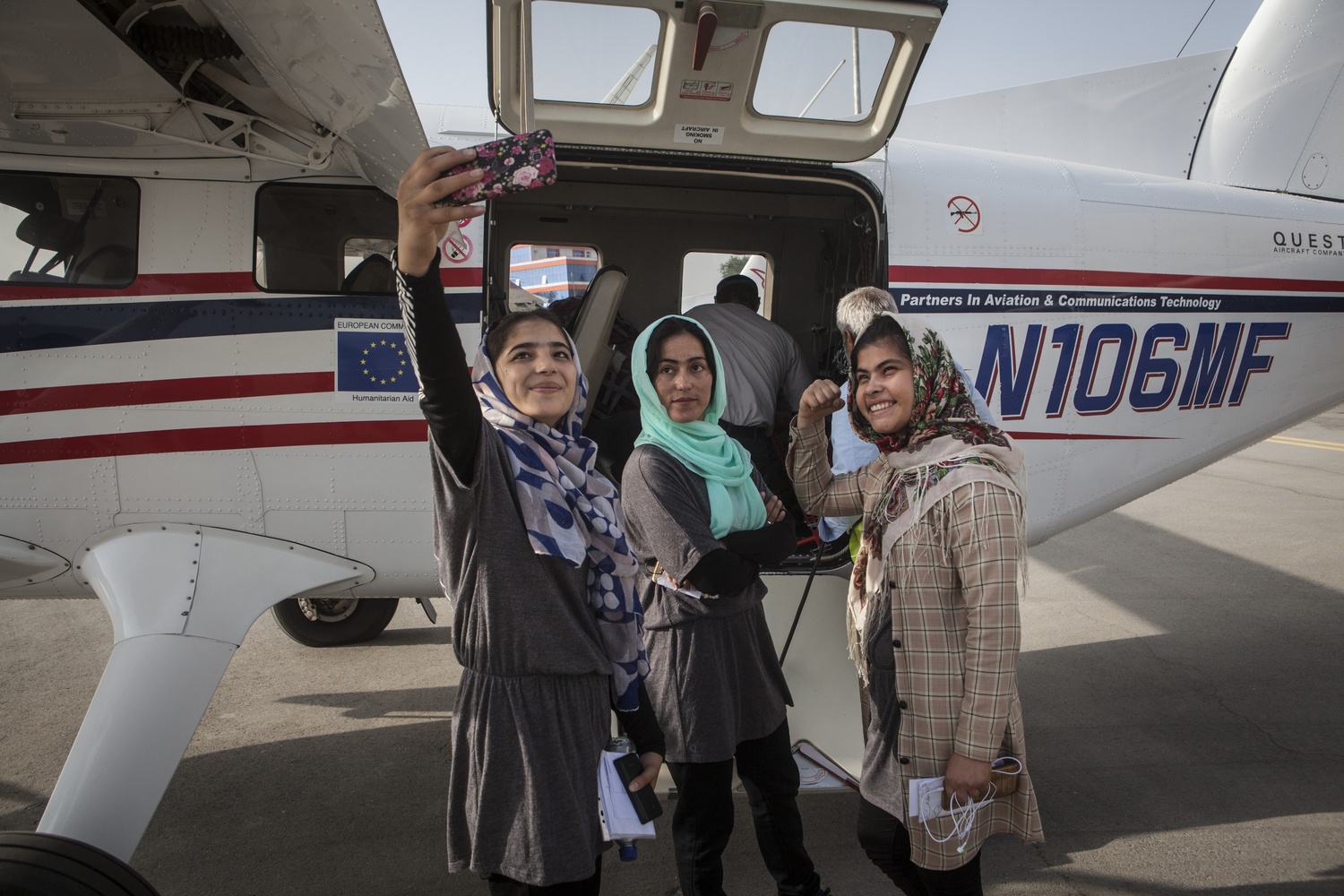
The expedition, which I joined as part of a book I’m writing, was run by the American organization Hanifa works for in Kabul, Ascend: Leadership through Athletics. The program recruits Afghan girls and women between the ages of 15 and 23 and encourages them to dream big while developing their confidence and skills to become leaders and entrepreneurs in their communities.
Ascend’s founder and executive director is Marina Kielpinski LeGree, a former aid worker with master’s degrees from Harvard and George Washington University. She is one of the few Westerners I know who truly understand Afghans and their prickliness about outside intervention. Fewer and fewer foreigners work in Afghanistan these days, and a growing number of organizations find it too risky. Taliban insurgents exert partial or full control in more than half of the country, while about 14,000 U.S. troops and some 17,000 from other NATO countries and partner states remain stationed there.
Ascend’s Noshaq climb was originally scheduled for the summer of 2016, but logistical hurdles and security threats delayed the trek. Unlike Mount Everest, located in a peaceful region with long-established supply routes, bustling base camps, and Sherpas who carry gear to oxygen-deprived heights, Mount Noshaq straddles a remote, volatile border between northeastern Afghanistan and Pakistan. There’s limited access to supplies and a dearth of experienced porters; many refuse to carry anything beyond Noshaq base camp at 15,500 feet.
On the day the trip was to start from Kabul, there was another dilemma: our charter pilots cancelled our flights because the Taliban had taken over the district next to the Afghan town of Iskhashim, where we were to land. The fighters had shot down an Afghan military helicopter, and our Western pilots feared that their small propeller planes could be next. Driving to the Mount Noshaq trailhead from Kabul isn’t an option either, because insurgents control much of the territory outside of Afghanistan’s cities.
Marina eventually arranged with a charter company to fly our team to a landing strip 11 hours by dirt roads from Iskhashim. We were further delayed by local Afghan officials afraid to grant access to a team of women climbers and journalists.
For Ascend program coordinator Freshta Ibrahimi, this was the last straw. When we reached the checkpoint at the trailhead, the police commander refused to let us through and called us “Siah-sar” which means “black head,” an Afghan pejorative for women. He explained while the trail was free of Taliban fighters, it wasn’t safe for women to hike.
“Well, is it safe or isn’t it?” Freshta asked, and then demanded he stop staring at her chest. Their testy exchange continued for 30 more minutes when she finally turned to me and said, “Let’s go, we’ve wasted enough time,” and stormed ahead up the trail.
***
By the time the whole team reached base camp three days later, it was late July and near the end of the window of ideal weather conditions for a Noshaq climb. That was about all anyone on the expedition knew for sure about Mount Noshaq, as no one in our group had ever climbed it before. There are no detailed maps of the mountain, few recorded accounts from those who have climbed it since a Japanese team first summited in 1960, and no clear routes between base camp and the top. It’s not considered a technical climb, and those who’ve reached the summit have generally done so without oxygen, but their numbers are low as decades of war in Afghanistan have kept most recreational climbers away.
It would have been easy to forget about this remoteness when we arrived at the busy base camp. Five Polish mountaineers (one of whom, Łukasz Kocewiak, was climbing solo) and another European team joined us on the rocky terrain where the few clean water sources had dried to a trickle.
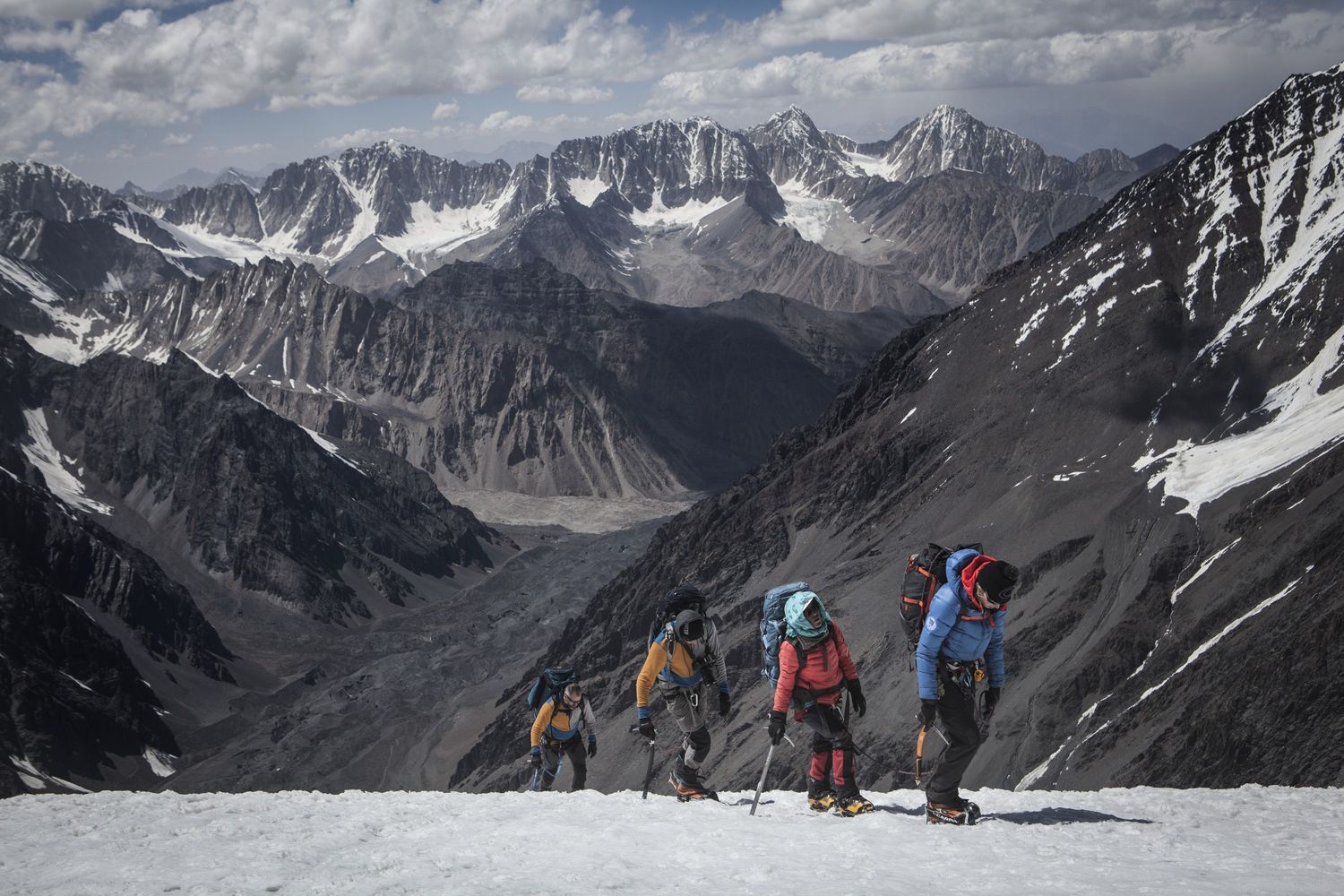
Hopes were beginning to diminish that all of the Afghan women would summit. The expedition leader, Emilie, and her Norwegian assistant, Vibeke Sefland, worried that the team lacked enough experience in the snow. After a frustrating training climb above base camp, the guides decided they would only lead a summit attempt with the strongest among the four Afghan women—Hanifa.

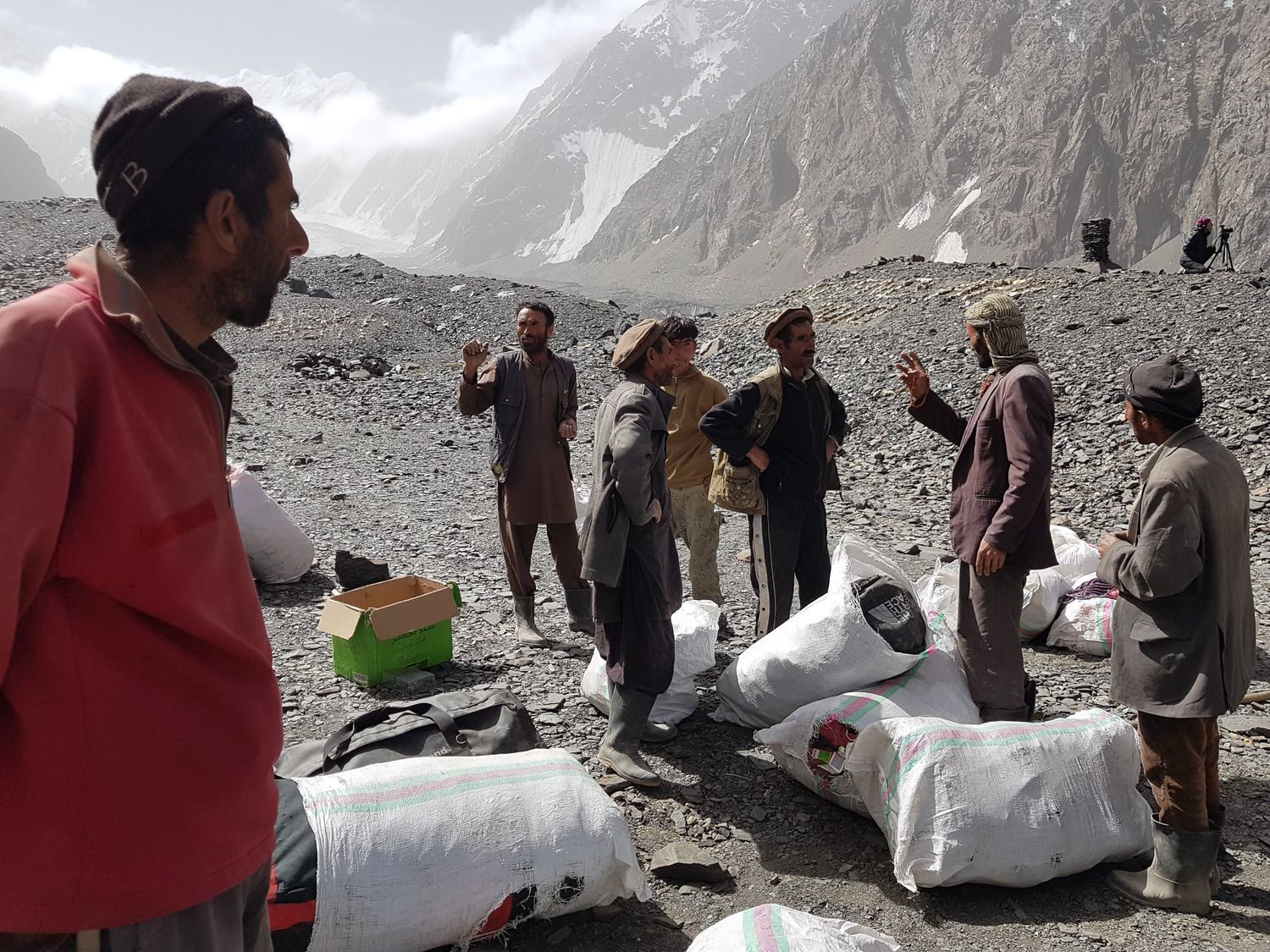
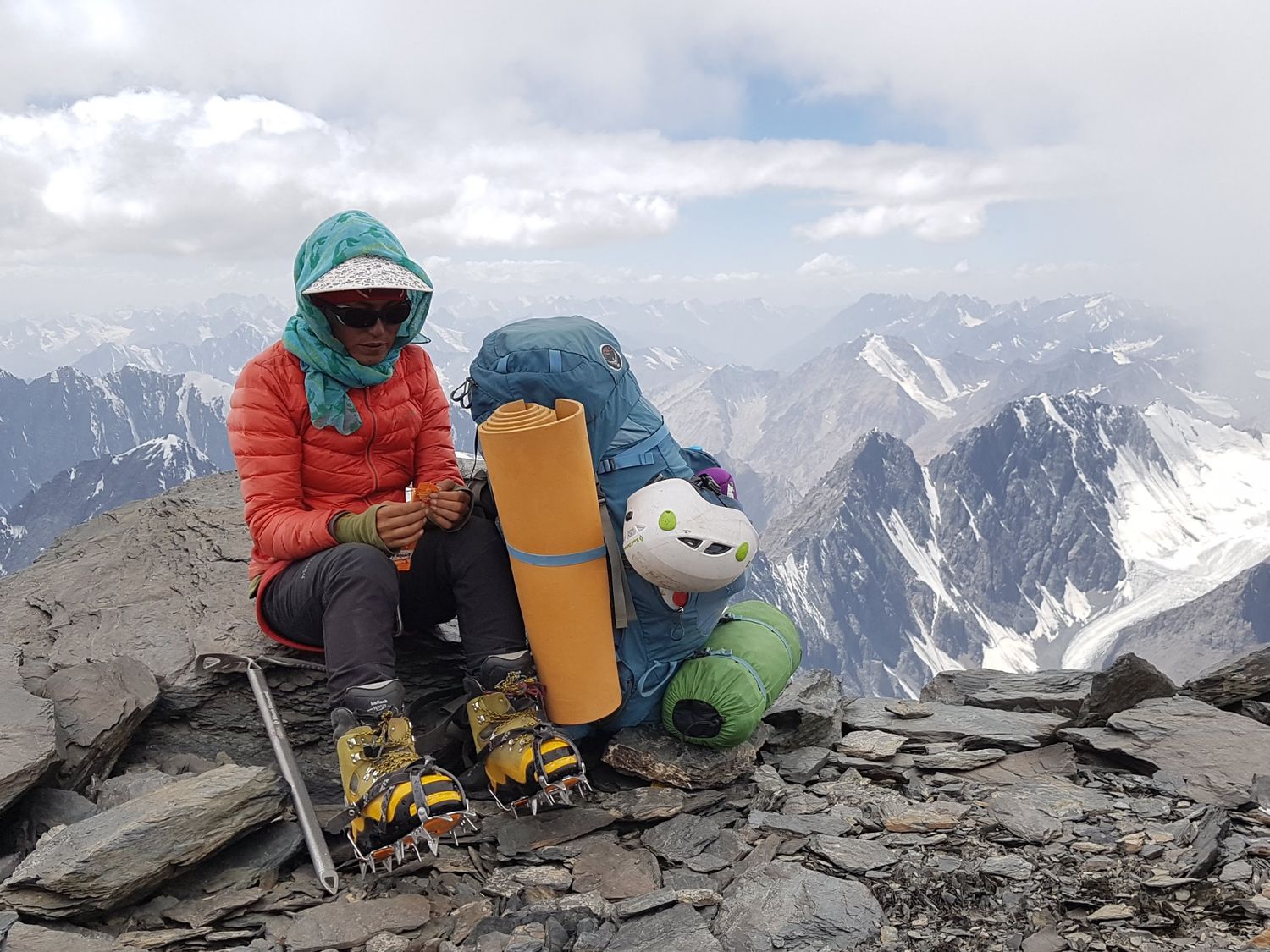
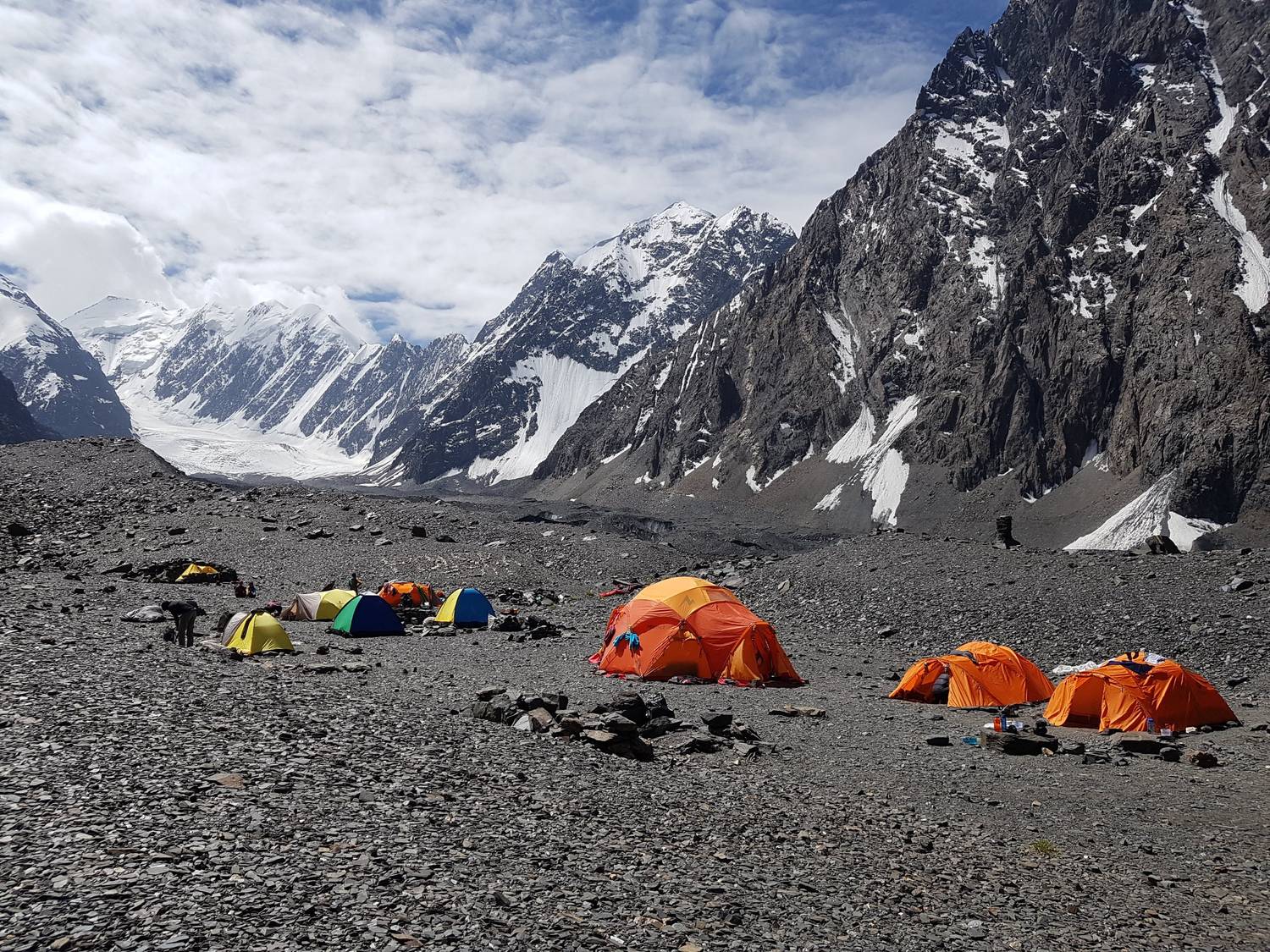
It was cold and sunny on 31 July 2018, when she set out in a turquoise head scarf and red down jacket to make history. Her two teenage teammates, Neki Haidari and Shogufa Bayat, were still brooding over their exclusion, but they dutifully helped Hanifa pack her clothing, gear, and food. They sent her off with hugs and promises to keep in touch via walkie-talkie.
Following her were Emilie and Vibeke and three film crew members, one of them a Scottish medic. The moraine wasn’t helping, either. Vibeke told me that much of the snow and ice had melted. “It’s loose and slides and stuff falls,” she said of the terrain. “It’s all shale, a terrible quality, so it’s not like a nice granite or anything [firm] like that.” She said she’d never seen anything quite like it, which is pretty telling, considering she’s climbed Mount Everest and other peaks that are higher and more challenging than Noshaq.
At first Hanifa—who speaks no English and was the only Dari speaker in the summit group—was doing just fine, “literally stepping on my heels,” as Emilie put it. That changed when she got to camp two, at 20,200 feet.
Hanifa slept fitfully that night and by morning showed signs of serious altitude sickness. Her dark eyes were glazed, her head throbbed, and she vomited up anything she ingested. Her oxygen levels had dropped to 49 per cent, which is well below the 70 per cent minimum considered safe at that altitude. Emilie said she and Vibeke decided that “Hanifa was done and had to go down” to camp one to recover.
But the young woman refused to leave. “I was afraid if we left, [Emilie] wouldn’t bring me back,” she explained. “We’d come so far and I didn’t want to give up getting to the peak.”
It took a conversation with the Polish climber, Lucasz, to change her mind. He was on his way down from the top of Mount Noshaq after becoming the first climber to summit it in years. At camp two, he spoke with Hanifa using hand gestures and a few English words she’d picked up. “He assured me that if I went back down and took care of myself, I would reach the summit,” she told me.
It took five more days for Hanifa to reach camp four, the last overnight stop before the summit. Emilie said it took them an hour of following Lucasz’s trail of frozen footsteps to get to the camp.
The sun was setting and Hanifa was again showing signs of altitude sickness, as well as hypothermia. (She eventually developed frostbite on her right big toe and small left toe, but has since recovered.) That night, Hanifa’s oxygen levels were down to 54 per cent, which isn’t dangerous but isn’t exactly great either, according to Vibeke. But by the next morning she had recovered and was eager to move on. “It was slow going,” Emilie said, with various team members taking turns breaking trail. “You are walking into snow that is deep and there is like a crust layer on top so you break in”. “And then you take another step and you’re hopeful that maybe you’ll stay on the surface but then you break in.”
“Everything is hard at that altitude, even taking a normal step,” Vibeke said, adding that they took lengthy breaks every half-hour or so, waiting for slower team members to catch up.
“Every step was so hard,” Hanifa agreed. “I took one step, then a breath, then another step and another breath.”
Emilie ended up descending with an ailing member of the documentary crew, so it was Vibeke who guided Hanifa to the top. They summited Mount Noshaq at 7 p.m., just before the sun went down.
Hanifa’s tears stung her wind-burned face as she reached into her pack and pulled out an Afghan flag. She offered a prayer of thanks. “I was so happy my exhaustion left me, and I was shaking, but I’m not sure if it was from excitement or cold.”
She raised her arms and hung on to the flag tightly as it fluttered wildly. Hanifa says she then shouted the names of all of the Ascend team members, hoping they’d carry on the wind. “I did this for them and all the women of Afghanistan.”
***
Overcoming her fear of what Afghans think of her summiting Noshaq has proven a lot harder for Hanifa than the climb itself. She yearns to be a role model who inspires other girls to climb, but at the same time is nervous about her neighbours in Kabul knowing what she has accomplished. “I’m afraid someone will throw acid in my face if they recognize me,” she says.
As a result, Hanifa refuses to do interviews with Afghan media. When, recently, she became the first Afghan woman to address the Royal Geographical Society in London, she told the audience about how she had panicked when she went to buy bread and saw a photo of herself on the crumpled piece of newspaper the baker used to wrap the still-hot loaf.
Fears like this led Hanifa, along with Freshta Ibrahimi, to vanish in London, 11 days after the Royal Geographical Society speech and only hours before they were to board a plane to Dubai en route to Kabul. According to their Afghan friends and relatives, they plan to file for asylum in the United Kingdom.
Marina is saddened by their decision, but tells me that she wishes them well and hopes the young women will reach out to her: “The burden of being afraid all of the time became too much for them to bear,” she adds.
The Ascend founder says she won’t give up on helping other Afghan women to become mountain climbers and leaders.
Next month, six of Hanifa’s teammates will train and test for a Single Pitch Instructor certification, offered through the American Mountain Guides Association for the first time outside of the United States.
If the Ascend team members pass, they will become their country’s first official rock climbing instructors, allowing them to teach other Afghan women to experience the freedom and security that Hanifa discovered above the clouds.




NEW ISSUE nº17





.jpg)
.png)
