


Looking for something specific? Enter keywords to discover content, stories and experiences.
Close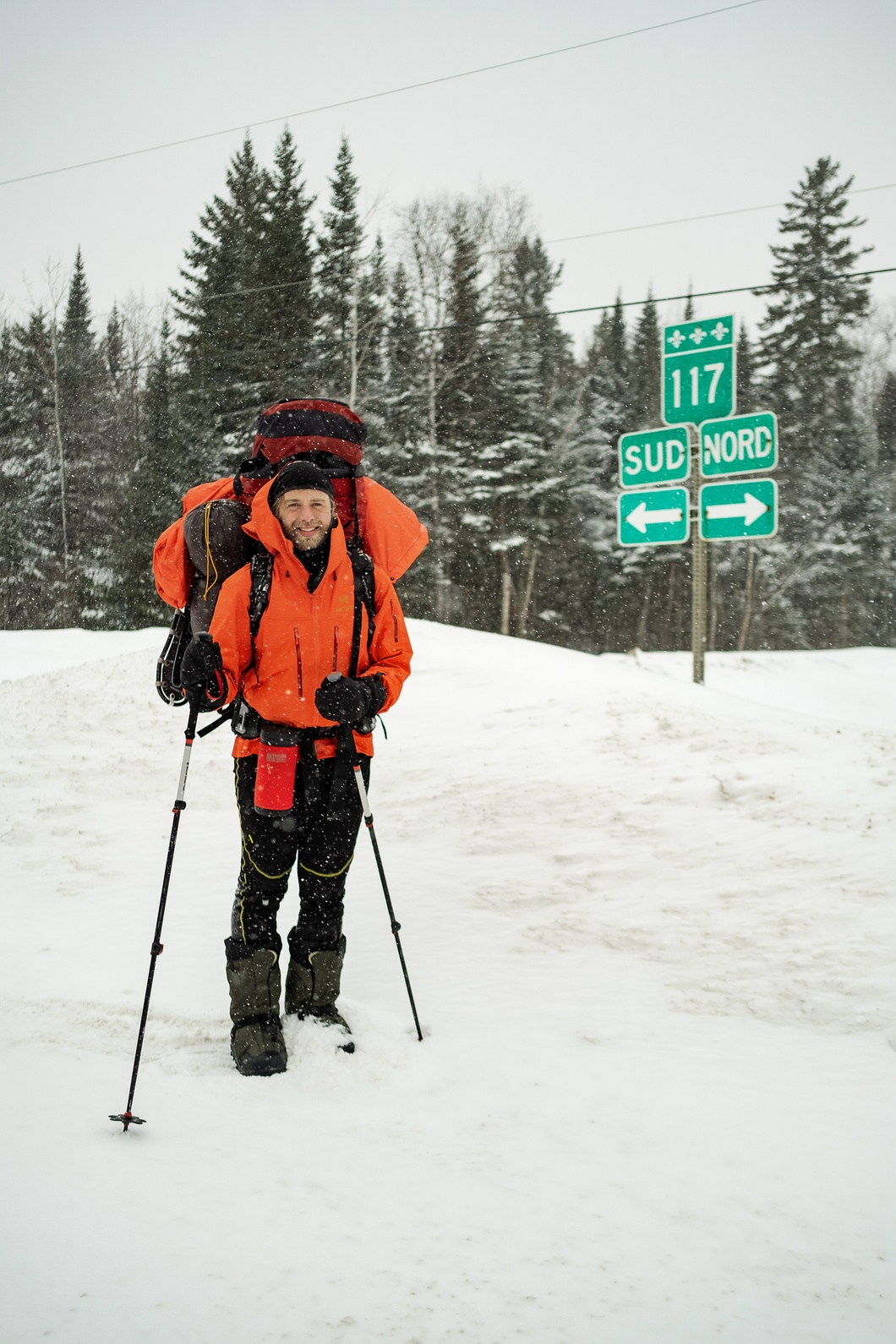
October 6, 2025
Photo
Dominic McGraw
October 6, 2025
Photo
Dominic McGraw
I’m walking along the edge of Highway 117, cross-country skis over my shoulder. I’m about 100 km from the nearest village when a car honks at me, making me jump. This road is not designed for pedestrians, the horn tells me aggressively. I turn my face from the salt, sand, and snow that swirl up in the car’s wake. I’m wet, dirty, and a little angry. I’m here because I’m trying to avoid the snowmobile trail that runs alongside the highway. I breathe through my nose—a few hundred more kilometres, and all this will be behind me.
In the winter of 2022 I set myself what I imagined to be a relatively straightforward challenge: to ski the 680 km from my home in Abitibi to the Radio-Canada headquarters in Montréal, where I had a column to deliver. I wanted to discover for myself this immense territory we call home, but know so little about.
Sitting in the comfort of my living room, I began making a list of the challenges on my expedition: logistics, food, physical prep, gear . . . nothing too stressful. I was used to managing things like this. Next, I started drawing up itineraries, keeping three constraints in mind: arriving at my destination before the snow melts in springtime, keeping my skis on as much as possible, and avoiding the shoulders of roads used by cars.
While the trip took shape easily at first, I was shocked to discover that all the forest paths leading out of the area had become snowmobile trails. Legally, you’re not allowed to be on them unless you’re on an off-road vehicle. But that wasn’t all. I also learned that more than 100 km of trails on the P’tit-Train-du-Nord, an old railway that has been turned into a bike path, are now reserved for ATVs during the winter months. Curious to know whether any exceptions existed, I made a few phone calls.
The result: not only was my project discouraged, but I was also threatened with a serious fine and told my trip would be surveilled. Even the departure from Rouyn-Noranda had to happen by the lake because the bike path that goes through the city was reserved for snowmobilers in the winter. It was illegal to ski on the path!
Forced to revisit my itinerary, I glimpsed a new possibility. One of the snowmobile trails that led out of the area would be closed for the cold season because of maintenance. I could use it to get to the gateway to the Upper Laurentians. After that, I would have to piece together a path along roadsides and abandoned or private forest roads all the way to Mont Tremblant.
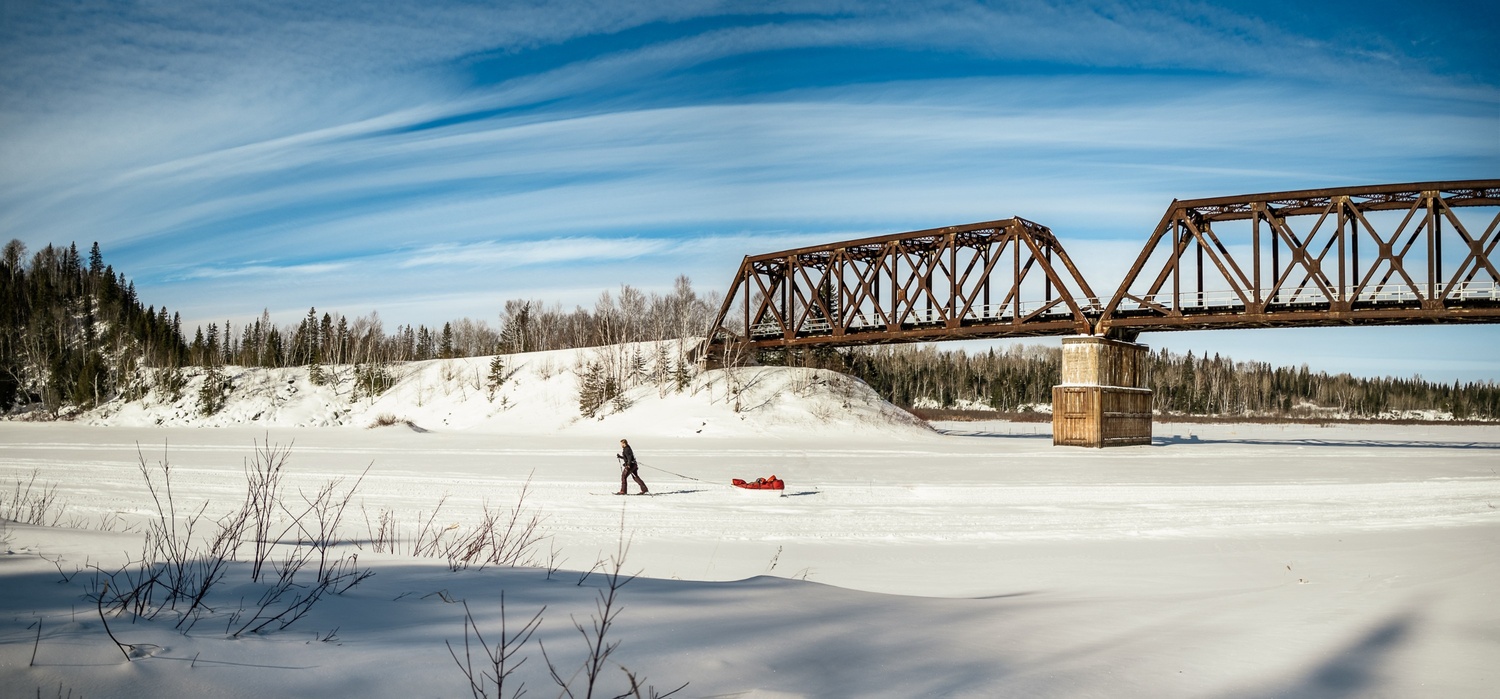
It was a tough pill to swallow. Was it really safer to take gravel roads where trucks pulling tons of wood rush past several times an hour? I was allowed to ski along the 117, one of the busiest highways in Québec, but I was forbidden to ski on a secondary forest road frequented by snowmobilers on vacation? To reach Montréal, I had to add 100 km to my itinerary in order to avoid what is, essentially, a bike path. I inwardly cursed the bureaucrat who had chosen to dismiss the notion of shared public infrastructure. And I would curse them again, a few weeks later, when passing cars sprayed me with salt and sand every 10 minutes.
When I meet a truck driver on the logging road in La Vérendrye wildlife reserve, he sums up the general feeling toward me with a single question: “Where’s your Skidoo?”
Clearly, it wouldn’t make sense to create ski trails across the immense La Vérendrye wildlife reserve just for one human being to cross it every 30 years. But how can it be that a bike path is inaccessible for active transportation for nearly six months out of each year? By comparison, the Norwegian city of Oslo and its surrounding forests have more than 2,600 km of ski trails. It’s hard to believe that Québec lacks cross-country ski lovers who would be interested in travelling the 200 km of the P’tit-Train-du-Nord between Saint-Jérôme and Mont-Laurier.
Does the absence of infrastructure for active transportation put people off, or does it accurately reflect the lack of demand?
In the city of Oulu, in northern Finland, average temperatures are colder than in Montréal. And yet, all winter long, 12 per cent of all transportation happens by bicycle. Moreover, 30 per cent of children under 12 use a bike to get around all year. Bike paths are cleared of snow well before the streets. Studies have shown that the abundance of adapted infrastructure largely explains the popularity of cycling in the city, where cars are a luxury item.
Of course, everything is a question of perspective and culture. Québec is not Finland. I know, too, that the snowmobile industry has critical economic benefits for the tourism sector. Still, isn’t it possible to imagine a more inclusive world in which some trails could be shared by snowmobilers and skiers in the winter, and by ATVs and bicycles in the summer? A world that encourages slow, contemplative, and predominantly non-motorized forms of outdoor activity?
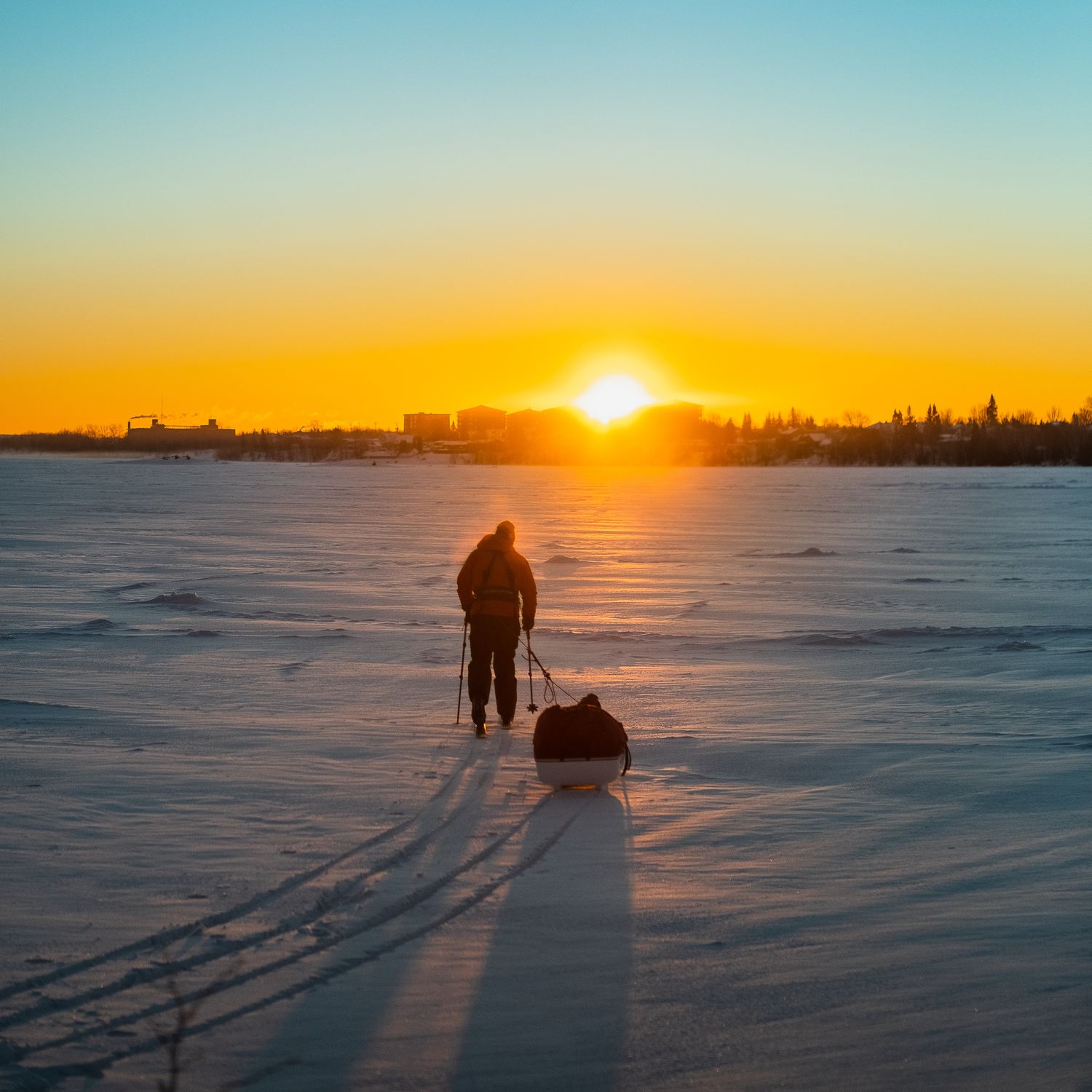
This expedition forever changed my perspective on this land that I’ve driven so often in a car. For 26 days, I travelled across 680 km at a speed of 5 km/h. I saw incredible sunsets, faced off with an American marten over a block of cheese, and watched the hoarfrost reflecting the colours of dawn in a scene drawn straight from a dream. When I set out, I knew the path I would travel was not adapted for skiing. The choice to expose myself to discomfort was an extraordinary luxury that I took on willingly so that I could enter into a deeper relationship with the land that surrounds me.
We have such pride in our wide open spaces, and yet we often explore them using modes of transport that cut us off from their sounds and smells. I’m convinced that if we changed our way of travelling the territory, we would also change our way of loving it. For the better.





NEW ISSUE nº17






.jpg)
.png)
